Why Durga rides a Tiger
Once, a man was raised on soft gods. Gods who offered comfort, approval, and endless second chances. These gods spoke in soothing tones and asked nothing too costly. The man grew clever in his temple, skilled at saying the right words while hiding the rot inside. He unconsciously worshipped emotional security and called it faith.
And then he met the Tiger.
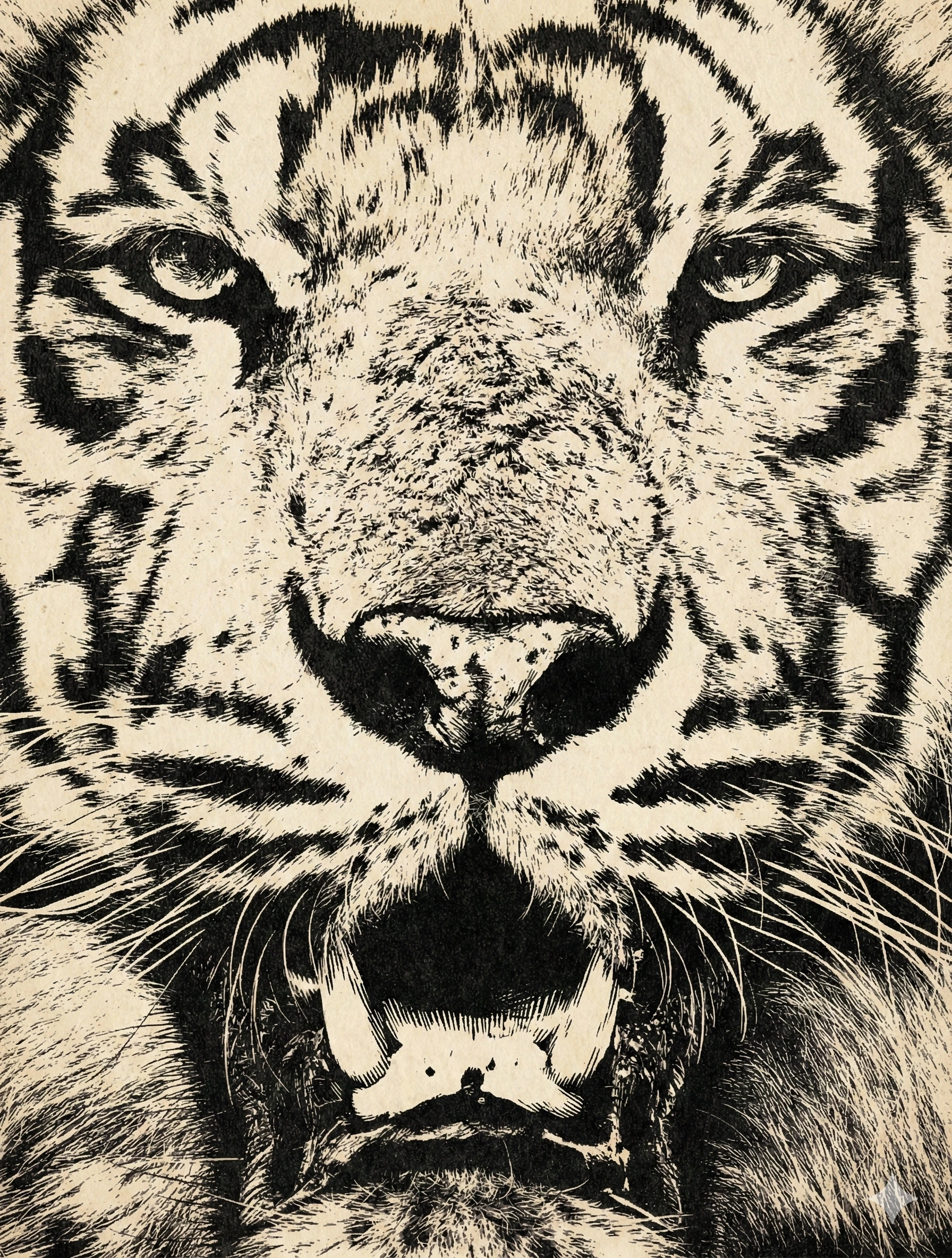
There’s a good reason why Goddess Durga rides the Tiger. The Tiger is the symbol of raw, unvarnished, grounded fact. It is the opposite of a fluffy, convenient spirituality.
Philosophically, the Tiger stands for aletheia: truth or fact as “unconcealment,” not mere correctness. It represents phenomenological ruthlessness towards whatever actually shows itself, regardless of whether it fits your identity or preferences. And Durga is that mode of being which does not flee from the givenness of experience, nor sugarcoat its harsh edges.
Pedestrian spirituality serves up a God who’s basically a cosmic babysitter. It tells you to be a good little boy, play nice, don’t get dirty. A bunch of hot air. Snake oil for the scared. But a man’s psyche eventually revolts and recoils against the infantilization of society and its prescriptions, of organized religion and its shibboleths.
Durga is that revolt embodied. It desecrates all idols. When “kindness” is used to defend convenient falsehoods, when “love” is deployed as control, the Tiger is chosen against this false mother. It is the instrument by which Durga refuses your attempts to edit reality down to what flatters you.
The Tiger is the living image of a strong, fierce, and incorruptible ally. It speaks to a psyche that is done with lies and now will give anything for the truth. And it represents everything pedestrian spirituality wants to control with its sermons: rage, lust, envy, grief, desire, fear, and also raw intuition and bodily knowing. It calls out self-deception.
It does not offer love and light as a sedative while one goes on living a life of convenient lies: years of subtle self-betrayal, relationships maintained past their truth, careers lived against inner knowing, religion and spirituality where doubt is taboo. Any system that quietly implies “reality is ultimately nice” is exposed. The Tiger says reality is what it is, not what you need it to be. It creates a thirst for something that cannot be negotiated with.
Meeting the Tiger is the collapse of cherished illusions about others, about life, about who you are. It clears psychic space by culling everything that is intellectual and not visceral. Everything that cannot withstand direct contact with reality will be burned or broken.
The warmth of clichés will give way to cold, simple seeing.
The Tiger is the inner apocalypse; the judgment day within. It is the end of your private false cosmology. “Everyone has their own truth” dissolves when the Tiger appears. Till now, you wanted to be safe, seen as good, and spared from your own depths. But now, there will only be truth, and all image, tribe, and continuity will be given up for it if necessary. It appears as principled resignation, or the quiet refusal to collude with bullshit and bumper stickers.
They say Norse berserkers wore no armor because rage itself was protection: a form of psychological warfare intended to instill sheer panic and terror in their enemies. Their disregard for personal safety made them seem less than human. The Tiger strips you of your armour and makes you fearless in the same way.
When a serious man meets the Tiger, he rides it butt-naked, oriented by an intelligence beyond the intellect. Riding the Tiger is an uncompromising journey, for Durga is the mother who loves you enough to not protect you from truth. The Tiger is her terrifying aspect; a non-sentimental realism infused with devotion to truth. It points out that the sacred is not elsewhere; it is the ferocity of events, the undeniability of consequence. No special spiritual context or attire is needed. Conflict, heartbreak, illness, failure, calamity — all become direct encounters with Durga’s Tiger.
When you meet the Tiger,
You won’t be able to pretend you don’t see what you see. The hollowness of society and its ten thousand prescriptions will become evident.
The texture of your kindness will change. You may not always be nice but you will always be free of conflict and contradiction. You will likely disappoint others who relied on your compliance. But you will exude a genuine warmth that is more trustworthy because you didn’t buy it by betraying the truth.
Your relationships will end or change form. You will redraw social contracts. Friends and partners will recalibrate when they realize emotional narratives, moviebrained notions, and half-truths no longer work on you. Some will either harden in their denial, some will feel secretly relieved. Some will leave; others will turn into more truthful connections.
You will begin to recognize the Tiger in others. You will see when someone is not being rude but being true; when a confrontation is an act of kindness; when a loss is a simple fact about reality, nothing less and nothing more. You will have a compassion that no longer colludes with delusion.
Your career will stall or pivot because you won’t do what it takes if it’s dishonest or not aligned with what you viscerally want.
Narratives will fail to sedate you. You will still consciously indulge in some, but as an honest byproduct of alignment, not as an anaesthetic or gift wrap on a shitty reality.
There will be no non-religious moment, no gap between the sacred and the mundane. Every confrontation with what is will be a form of worship, whether acknowledged or not.
You will understand that divine judgment is not vindictive, but the refusal of the truth to participate in your self-deception.
You will lose the narcotic of being “the good one.”
You will have less inner noise; fewer self-justifying monologues inside your head.
You will experience a strange, almost animal-like looseness and calm.
Your only authority will be in the lived fact of experience. The moviebrain will lose jurisdiction over your life.
You will stop making sense to others. Gregor Samsa woke up as a beetle and lost his ability to communicate with people around him. His family could no longer understand his speech, and he gradually lost the ability to understand their words fully as well, deepening his isolation. Meeting the Tiger is similar — you will become incomprehensible to those around you.
You will ask, “Who am I in a way that makes sense to others?” but you will find no satisfactory answer.
And when all your explanations exhaust themselves, only the Tiger will remain.